
Why Forgiveness Doesn’t Have to Be So Damn Serious
Practical Wisdom: Living 5D in a 3D World
Integrating higher consciousness into everyday life—one miracle at a time!
Forgiveness is not a punishment for having listened to the ego. It is the moment we remember we don’t have to keep listening.
Hi Beloved,
What if forgiveness were much simpler than we have made it?
What if it did not require a solemn ceremony, an emotional excavation, or a perfectly spiritual response?
What if forgiveness could begin with five lighthearted words:
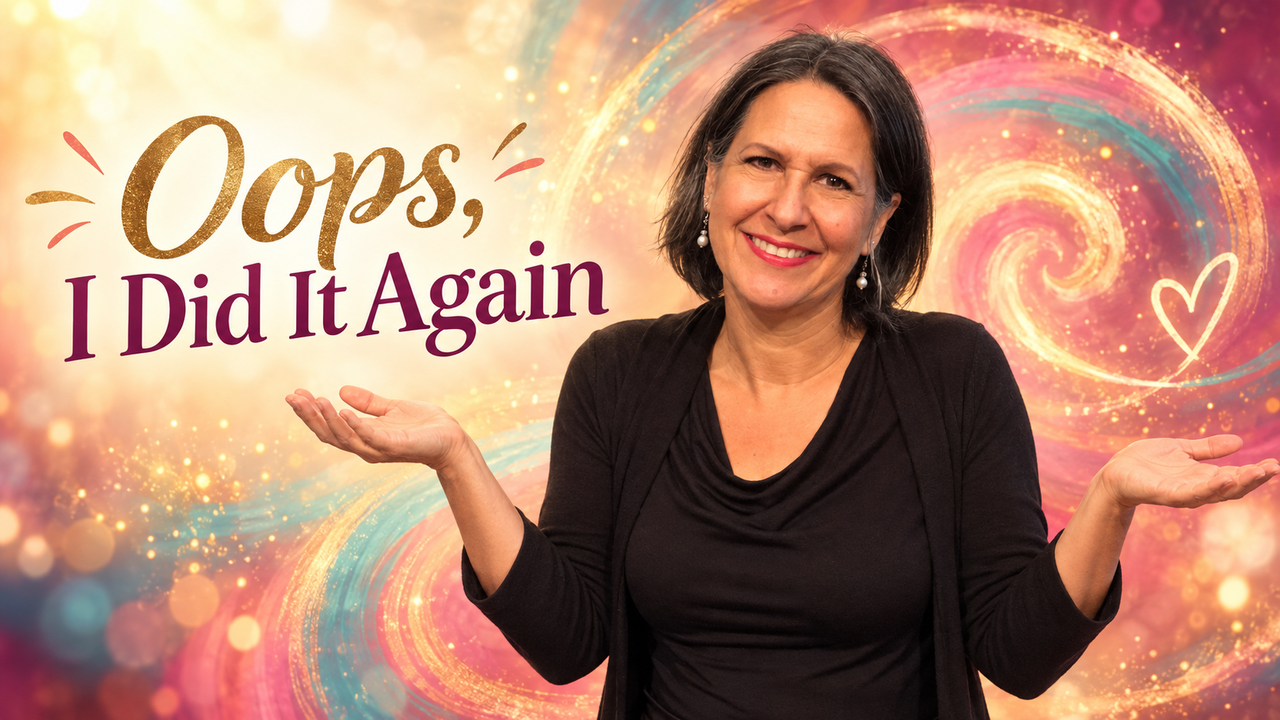
Oops, I did it again.
I listened to the ego.
I believed the commentator in my head.
I withheld love because someone failed to behave according to my commentator's expectations.
I traded my peace for the temporary satisfaction of being right.
And for a moment, I forgot what I am.
Oops!
There is nothing shameful about recognizing that we chose the ego/commentator. In fact, the moment we can see the choice without defending it, condemning it, or building an identity around it, we are already free to choose again.
The ego wants even forgiveness to become serious. It wants us to turn a momentary mistake into another reason to judge ourselves:
I should know better.
I have been studying A Course in Miracles for years.
How could I let this upset me again?
But self-condemnation is not forgiveness. It is merely the ego wearing a spiritual mask.
True forgiveness does not say, “You failed again.”
It says:
You forgot. Now you remember.
Forgiveness Is Not Denial
A Course in Miracles tells us that we are forgiving our brothers for what they did not truly do.
This can be one of its most difficult teachings to accept—especially when we have evidence.
We have the text messages.
We have the photographs.
We have the witnesses.
Hell, it may even be on video!
So let us be very clear: forgiveness does not require us to pretend that something did not happen within the human experience.
The betrayal happened.
The abandonment happened.
The cruel words were spoken.
The body may have been harmed.
The Course is not asking us to deny what occurred in 3D form. It is inviting us to deny that what occurred has the power to change the eternal truth of who we are.
Yes, my father abandoned our family when I was a child.
That happened within my human story.
But his actions did not diminish the Self God created. They did not remove the Love within me, damage my eternal innocence, or alter my worth.
What happened to the body and personality is not the final truth about me.
Forgiveness is how I stop allowing an event from the past to dictate the quality of the Love, peace, and joy I experience now.
That is not denial.
That is the reclamation of my power.
Who Suffers When I Withhold Love?
When someone does something we dislike, the ego offers what appears to be a perfectly reasonable solution:
Withhold love.
Judge them.
Replay the story.
Make them wrong.
And above all, remain offended until they understand what they did.
The problem is that every bit of love I withhold from another is first withheld within me.
Every judgment contracts my body.
Every grievance occupies my mind.
Every resentful thought interrupts my peace.
The other person may be at the beach drinking a piña colada while I conduct an imaginary trial in my head.
Who, exactly, is being punished?
Once I became aware of this, forgiveness stopped being something generous I did for another person. It became something wonderfully selfish I did because I wanted to feel good.
I value peace.
I value joy.
I value freedom.
And there is no amount of righteousness, resentment, or egoic vindication worth sacrificing those things.
The Commentator Is Not the Witness
Most of us don't directly experience our lives. We are listening to the commentator in our heads describe them.
She did not invite you because she doesn’t respect you.
He said that because he wants to hurt you.
They should appreciate you more.
This should not be happening.
How could they do that?
Like a sports announcer, the ego provides the play-by-play, the statistics, the history, and its predictions for what will happen next.
Then we mistake its commentary for reality.
Awareness allows us to step back from the broadcast and ask:
Is that actually true?
When did this thought system begin?
What happens within me when I believe it?
Do I still want to value this thought?
Every thought system has a beginning. The belief may have started in childhood, when we concluded that being excluded meant we were unworthy, that someone leaving meant we were unlovable, or that pleasing others was necessary for our safety.
Forgiveness takes us back to the beginning—not so we can endlessly analyze the past, but so we can stop dragging an old conclusion into the present.
The commentator may continue talking.
Awareness simply stops treating it as God.
A Little Willingness—and Then a Lot
The Course repeatedly asks us for a little willingness.
A little willingness to question our interpretation.
A little willingness to admit that perhaps we do not know what anything is for.
A little willingness to consider that there may be another way of seeing.
That tiny opening is enough for the Holy Spirit to enter.
But living from that awareness requires what the Manual for Teachers calls abundant willingness. We may have to choose hundreds—or thousands—of times again.
This is not failure.
This is mind training.
We are not expected to become forgiveness machines who never experience anger, hurt, or judgment. We are learning to recognize more quickly when we have allowed an egoic thought to block the Love we are.
We usually recognize it after lifetimes.
Sometimes we recognize it after ten years.
Sometimes after ten minutes.
Sometimes we catch the thought before it finishes the sentence.
Every moment of recognition is progress.
There is no need to announce:
“I cannot believe I have done this again!”
Just smile and say:
“Oops. I forgot that Love is what I am.”
Then choose again.
Stop Valuing What Hurts You
One of the most transformative ACIM practices in my life came from Workbook Lesson 133:
“I will not value what is valueless.”
Years ago, what I valued included the usual things: a beautiful home, professional success, money, recognition, my looks and body, and being perceived a certain way.
Eventually, the list changed.
I began to value peace.
Joy.
Truth.
Freedom.
The experience of God moving through me.
Then the contradiction became impossible to ignore.
If I value peace, I cannot simultaneously value thoughts that disturb it.
If I value freedom, I cannot continue worshipping beliefs that bind me.
If I value Love, I cannot keep insisting that withholding Love is protecting me.
A grievance remains alive only because some part of us still believes it has value. Perhaps it proves we were right. Perhaps it confirms that we were mistreated. Perhaps it protects an identity built around what happened.
But if maintaining that identity costs us our peace, it is too expensive.
Forgiveness is the moment we finally decide:
This story is no longer worth what it costs me.
Forgiveness Does Not Make Us Passive
Releasing judgment does not mean surrendering discernment.
We can recognize that something is dishonest, cruel, corrupt, or harmful without making hatred our contribution to it.
We can establish boundaries.
We can leave relationships.
We can decline invitations.
We can quit the job.
We can stop supporting systems and businesses that conflict with our values.
We can choose where we spend our time, attention, energy, and money.
Forgiveness does not require us to play with every character in the dream. It simply frees us from condemning those we choose not to play with.
When people or systems show us what we do not want, they offer contrast. That contrast can return us to the only meaningful question:
What do I value—and how can I place my energy there?
We do not co-create the Happy Dream by battling the nightmare.
We withdraw our allegiance from fear and give our power to what reflects honesty, freedom, compassion, and the greater good.
That is forgiveness made visible.
Integration in Daily Life
The next time you feel offended, contracted, or determined to prove that someone else is wrong, pause and ask:
1. What am I feeling?
Notice what is happening in your body without judging it.
2. What thought am I believing?
Listen beneath the emotion for the ego’s interpretation.
3. What am I withholding?
Is it Love, peace, acceptance, compassion, or joy?
4. Who experiences that withholding first?
Be honest about the cost of carrying the grievance.
5. What do I truly value?
Do you value being right—or being free?
Then take a breath and say:
Oops, I did it again.
I forgive myself for forgetting that Love is what I am.
You do not need to force affection, manufacture a holy feeling, or pretend the situation was acceptable.
You are simply releasing the belief that withholding Love will save you.
Let the mistake be corrected.
Let the contraction soften.
Let yourself return.
Lainaism
Forgiveness is not saying, “You didn’t hurt me.” It is saying, “What happened does not get to decide who I am—or how much Love I allow myself to feel.”
When Forgiveness Becomes a Way of Living
The purpose of forgiveness is not merely to help us recover after the ego has taken us on another joyless detour. Practiced consistently, it creates the inner spaciousness through which guidance can actually be heard. We stop forcing answers, defending our interpretations, and treating every decision as if the fate of the universe depends upon it. Instead, we surrender, listen, choose—and when we forget, we lovingly choose again. Peter’s beautiful message arrived as a living reflection of this practice: when spiritual principles guide everyday decisions, life becomes more joyous, clear, and inspired.
A Beloved’s Experience
—Peter, Practical Wisdom reader
Hello Laina! Please keep up your wonderful, insightful, so timely writings! I have been following Michael Singer’s Surrender Experiment using A Course in Miracles, Way of Mastery, Wisdom Untethered, and your writings as guides to decision-making and staying on track. In the process, life is becoming ever more joyous and clear!!! Keep writing, and I’ll keep responding. Especially in light of an interesting “political” project coming up for which I’ll need my best wits and guidance to navigate. I’ll keep you apprised. Thank you, again!!! Love, Peter
Closing Transmission
Beloved, you have never sinned against Love.
You have only forgotten that Love is what you are.
You may have listened to fear.
You may have chosen judgment.
You may have used a grievance to build a wall and then wondered why you felt imprisoned.
But none of that changed what God created.
The wall was never stronger than the Love behind it.
The mistake was never more powerful than your willingness to see differently.
And the egoic choice you made fifty years ago, five years ago—or five minutes ago—does not require a lifetime sentence.
You are allowed to notice.
You are allowed to laugh.
You are allowed to choose again without turning your forgetting into another crucifixion.
Forgiveness was never meant to make you a better prisoner.
It came to open the door.
So when you catch yourself withholding Love, defending your suffering, or treating the latest scene in this absurd human adventure as if it has rewritten eternity, take a breath.
Smile at the mind that briefly wandered away from Truth.
And remember:
Oops, I did it again.
Thank God I can choose again.
Giggling with you,

Founder, The Awareness Academy
"Forgiveness is the key to happiness."– ACIM Lesson 121
My Invitation:
If you are ready to stop merely studying forgiveness and begin experiencing the freedom it offers, join us inside the Awareness Academy. Together, we practice recognizing the ego without condemning it, releasing the thoughts that bind us, and living A Course in Miracles where it matters most—in the ordinary moments of our lives.
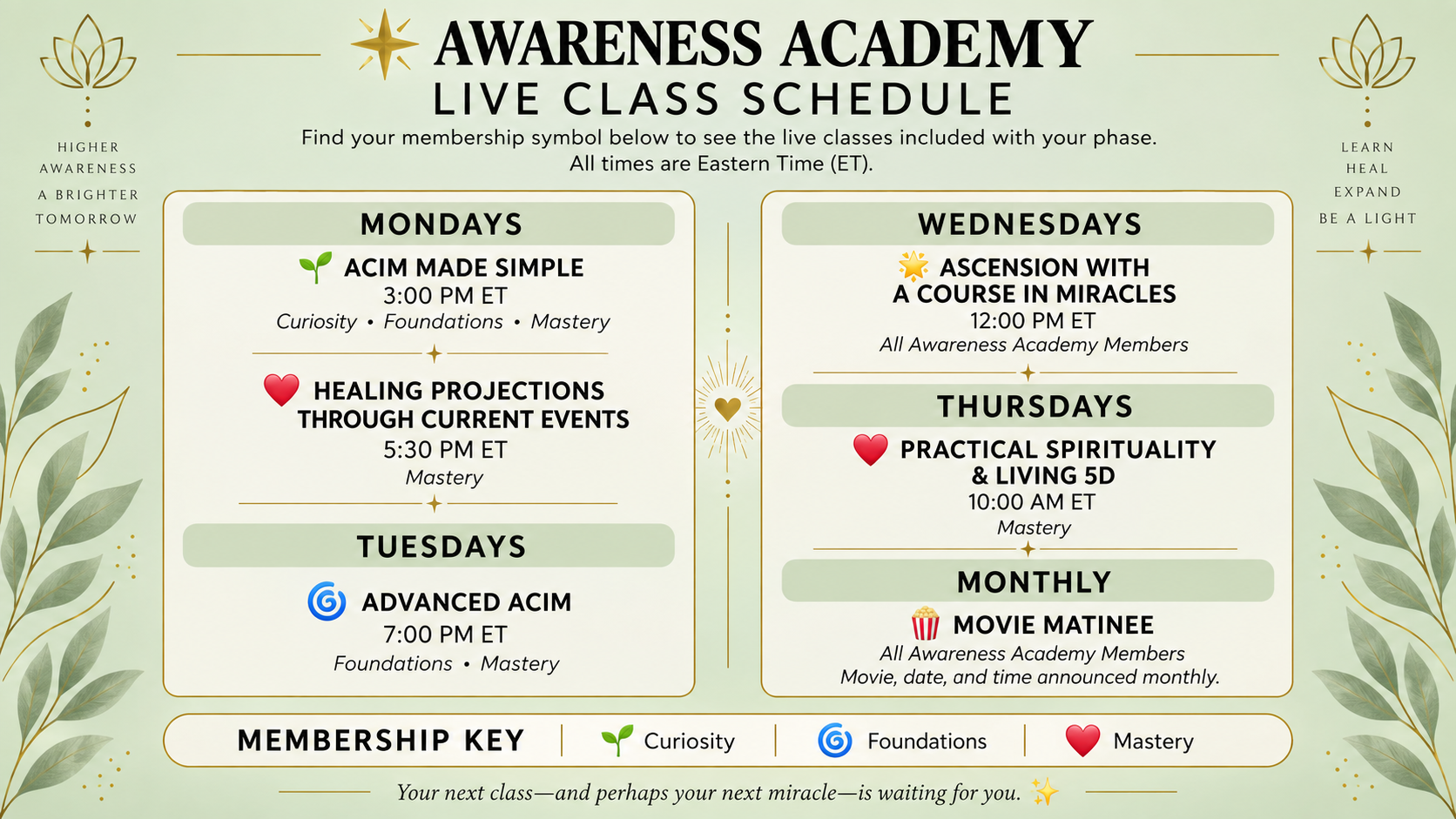
Here's a list of our ongoing classes:
“This Practical Wisdom was inspired by my joy-filled conversation with Eric about living A Course in Miracles, practicing forgiveness, and discovering the freedom of not taking this human adventure so damn seriously. [Watch our full conversation here.]





Responses