
Practical Wisdom: Living 5D in a 3D World
Integrating higher consciousness into everyday life—one miracle at a time!
Happy New Year, Beloved!
Over the past year, I’ve been on an unexpected and profoundly illuminating journey—one that moved through my mouth, my bloodstream, my beliefs, and straight into the heart of my spiritual practice.
This journey asked me to live—not just recite—the teachings of A Course in Miracles.
For decades, I carried silver fillings and multiple root canals, never questioning dental paradigms I had been taught to trust. Yet over time, my body began whispering… then insisting… then finally demanding my attention. Unusual fatigue. Lingering infection. Sinus issues that would not resolve. A slow but steady draining of vitality.
And still—my Spirit remained untouched.
ACIM reminds us:
“I am not a body. I am free.” (Lesson 199)
“I am under no laws but God’s.” (Lesson 76)
These are not bypasses. They are anchors.
They allowed me to remain peaceful while I listened honestly to my body—without fear, denial, or spiritual bravado.
What I discovered was sobering and empowering all at once:
Dead teeth left in the mouth after root canals can become silent breeding grounds for bacteria—bacteria that can migrate into bone, sinuses, and even the bloodstream, usually becoming toxic. Also, dental amalgam fillings (silver fillings) contain mercury that, over time, can leak into the body and reach the bloodstream. I learned this more deeply through the documentary Root Cause (now banned by the American Dental Association), and then confirmed it through my own lived experience. (I placed links to some of my research below.)
During an emergency appointment on New Year's Eve, my biological dentist finally removed three severely infected teeth, one with a long-standing root canal—she scraped infection from my jawbone itself. Ozone was applied. My own blood and stem cells (PRF Platelet-Rich Fibrin) were used to support natural healing.
This was not cosmetic dentistry.
This was life-preserving care.
And yes, I chose antibiotics—consciously, temporarily, lovingly—because wisdom is not rigidity. Love adapts once we accept that we are in the world but not of it.
What moved me most was not just the physical healing already underway, but the inner clarity this experience brought.
ACIM says in Chapter 2, The Atonement of Defense, that true denial is not hiding error, but correcting it. I can deny—truthfully—that anything not of God can affect my Spirit… while still addressing what arises in the human experience with intelligence and care.
My Spirit has never been sick.
My peace has never been threatened.
And my body deserved my kindness—not my neglect.
This journey has also clarified something bigger.
Old systems often serve us—until they don’t.
The American Dental Association, like many institutions rooted in a 3D Rockefeller-era mindset, has emphasized symptom management over root causes. That paradigm has shaped modern medicine in powerful ways… and it is also giving way to something new.
Biological and holistic dentistry represent a 4D bridge into what ACIM calls the Happy Dream—a world where healing honors the whole, where love of self is not indulgence but responsibility, and where Spirit informs the body rather than dismissing it.
“Beyond this world there is a world I want.” (Lesson 129)
That world is not someday.
It is being chosen—right now—by those willing to listen, learn, and love themselves enough to evolve.
I share this story openly because I am no longer interested in being spiritually correct at the expense of being honest. I want my life to reflect integration. I want my students to know that awakening does not require suffering. And I want us to remember that caring for the body is not a contradiction to Truth—it is often an expression of it.
Lainaism
“Awakening isn’t denying the body.
It’s letting Spirit lead how the body is loved.”
The more I acknowledge that my Spirit cannot be harmed by anything in this world, the more I feel an exquisite, undeniable sense of self-love. Not egoic love. Not compensatory love. But the quiet recognition of God loving Itself as me.
This is the transformation ACIM makes possible.
This is what it looks like when teachings move from pages into practice.
And this is the Happy Dream—being lived, one loving choice at a time.
With deep gratitude,

Founder, The Awareness Academy
“There is another way of looking at the world."—ACIM, Lesson 33
Being the Light in 2026
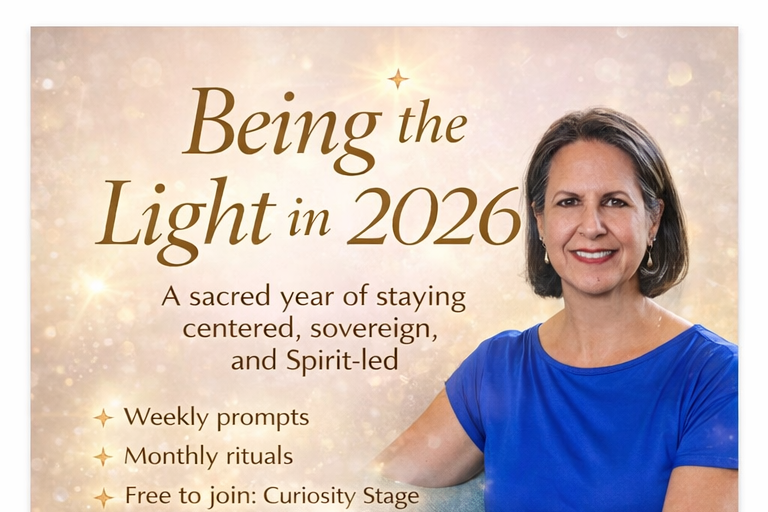
Join me starting on Monday, January 5, 2026, in the Community Feed as we embark on this sacred weekly journey together! Free to all members of the Awareness Academy.
Not a Member Yet?
If this message resonates, take a breath and notice where Spirit might be inviting more kindness toward your body today.
No fixing.
No forcing.
Just listening.
👉 Log in to the Academy and Join US
Here's a list of our ongoing classes:
-
Live ACIM Basic Class for all members in the Curiosity Stage (open to all members): Mondays @ 3:00 PM EST
-
❤️ Live Healing through Current Events for the Mastery Stage: Mondays @ 6:00 PM EST
-
🌀 Live ACIM Advanced Class for the Foundation Stage: Tuesdays @ 7 PM EST
-
🌟 Ascension with ACIM: Wednesdays @ 12 PM EST
- ❤️ Live Practical Spirituality and 5D Living: Thursdays @ 10:00 AM EST
Join The Awareness Academy
Deepen your trust, your joy, and your peace as we walk the path of the Awakening Christ together!
Links:
Root Cause documentary
|
Root Cause is a 2017 feature-length documentary following Australian filmmaker Frazer Bailey's 10-year search for the source of his chronic illnesses. The film gained widespread notoriety after its release on major streaming platforms like Netflix in late 2018, leading to intense controversy and its eventual removal from most mainstream services.
Controversy and Dental Response
- Scientific Rejection: Major dental organizations—including the American Dental Association (ADA), American Association of Endodontists (AAE), and the American Association for Dental Research (AADR)—denounced the film as spreading "junk science" and misinformation.
- Netflix Removal: Following a coordinated effort by medical and dental societies—including letters to the platform's leadership—Netflix pulled the documentary from its library in late February 2019.
• Current Status: While no longer available on Netflix, the documentary can still be found on Apple TV and other niche digital platforms, where it continues to be cited within the holistic dentistry community.
 |
Mercury Dental Fillings Raise Blood Mercury to Dangerous Levels in 100+ Million Americans
The International Academy of Oral Medicine and Toxicology (IAOMT) brings attention to an important new study, titled “Dental Amalgams and Blood Mercury Concentrations in American Adults.” The study provides convincing evidence that mercury amalgam dental fillings are elevating blood mercury levels to dangerous thresholds, and that blood is a key pathway for mercury distribution in the body.
Dental amalgam, a relic of a bygone era, has been used for over 150 years in U.S. dentistry to repair decayed teeth and contains 50% toxic elemental mercury, which is converted to inorganic mercury once inside the body. Data from the CDC’s National Health and Nutrition Examination Survey (NHANES) indicates that roughly 104 million Americans have mercury amalgam dental fillings.
The study analyzed data from the CDC’s 2015–2016 NHANES survey, using blood mercury measurements from U.S. adults aged 18–70 to estimate exposures across 180 million Americans.
The study revealed that adults with amalgam fillings have significantly higher blood inorganic mercury levels than those without. The number of amalgam surfaces strongly correlates with increased mercury levels in blood, with an estimated 16 million adults exposed to daily mercury vapor doses exceeding the U.S. EPA’s safety limit.
The research also highlights blood as a key pathway for mercury vapor from dental fillings to accumulate in tissues and cells throughout the body, underscoring serious health risks, especially for vulnerable groups. Recent studies have linked amalgam mercury exposure to increased risks of asthma, arthritis, hearing loss, neurological disorders, and perinatal death.
Holistic Life Dentistry - My Dentist
 |




Responses