
What If Everything You've Been Trying to Get Rid of Is Actually Showing You the Way Home?

Practical Wisdom: Living 5D in a 3D World
Integrating higher consciousness into everyday life—one miracle at a time!
Beloved,
What if your spiritual journey isn't about becoming a better version of yourself?
What if it's about remembering who you are beneath everything you've been taught to believe?
And what if the very experiences you've been trying to eliminate—your fears, irritations, attachments, disappointments, and frustrations—are actually helping you remember?
Now THAT would change the game, wouldn't it?
Most of us approach spirituality with the same mindset we bring to everything else.
We want to get somewhere.
Get healed. Get enlightened. Get peaceful. Get rid of fear. Get over the past. Get the relationship, the money, the health, the recognition, or the circumstances that will finally allow us to feel whole.
And if we're especially spiritual, we might even want to get rid of our ego!
But what if the desire to get somewhere is precisely what keeps us from recognizing that we've never left Home?
This is where A Course in Miracles offers us a radical invitation.
Not to become something more.
But to question everything that convinced us we were something less.
1. The First Lesson: Undoing the Concept of Getting
In Chapter 6, Jesus introduces one of the most challenging lessons for the ego: undoing the concept of getting.
Why is this so difficult?
Because the ego's entire thought system rests on the belief that something is missing.
It tells us we are incomplete, vulnerable, separate, and lacking. And then it generously offers to help us find whatever it insists we don't have.
How convenient!
The ego says:
When I get more money, I'll feel secure.
When my partner changes, I'll feel loved.
When my children make better choices, I'll feel peaceful.
When my body heals, I'll feel whole.
When we elect a different POTUS, I'll feel safe.
When I finally understand the Course, I'll awaken.
Notice the common thread?
Peace is always somewhere else, waiting for something else to happen.
And that's the trap.
The ego convinces us that having something will change what we are.
But having and Being are not the same thing.
You can have money without experiencing abundance.
You can have a relationship without experiencing love.
You can have perfect circumstances without experiencing peace.
You can have a new President without experiencing safety.
And you can have none of those things and still know yourself as whole.
This doesn't mean we shouldn't enjoy money, relationships, health, beautiful experiences, or anything else this world offers.
Good heavens, enjoy the whole playground!
It simply means we stop asking the playground to tell us who we are.
The first lesson isn't about giving up what we have. It's about letting go of the belief that what we have determines who we are.
That distinction changes everything.
2. The Second Lesson: To Have Peace, Teach Peace to Learn It
Here comes another beautiful reversal of the ego's logic.
The ego teaches us that we must first possess something before we can give it.
First become peaceful. Then extend peace.
First become loving. Then offer love.
First become whole. Then help others.
But Jesus reverses that thinking.
In Chapter 6, he teaches us that to have peace, we must teach peace to learn it.
Why?
Because teaching is not merely something we do for another person.
Teaching demonstrates what we believe is true.
When I respond to someone's fear with gentleness, I am reinforcing the reality of gentleness within my own mind first.
When I refuse to condemn someone who has made a mistake, I am first learning that condemnation is unnecessary for me, too.
When I remember that another person is more than their behavior, I first strengthen my own remembrance that I am more than my behavior.
This is not about pretending to be peaceful when we're not.
That's just the ego wearing a spiritual costume.
It's about becoming willing to choose another teacher, another interpretation, another way of seeing.
Sometimes that willingness begins with nothing more profound than:
Oops! There I go again!
And suddenly, a little space opens between the thought and our belief in it.
That's where the adventure begins.
3. The Ego's Favorite Disguise: Making Everything Complicated
After years of studying and teaching ACIM, I've come to appreciate just how clever the ego can be.
It doesn't always announce itself through anger, jealousy, or obvious fear.
Sometimes it sounds incredibly reasonable.
Sometimes it sounds responsible.
Sometimes it even sounds spiritual.
It tells us we need to analyze our childhood one more time, understand our triggers more deeply, perfect our forgiveness practice, or reach some higher level of consciousness before we can finally experience peace.
And because these activities can sound so worthwhile, we may not notice that we've turned awakening into yet another acquisition.
Another thing to get.
Another destination to reach.
Another reason we're not quite enough yet.
Oh, that sneaky little rascal! 😂
I've had students walk beside me for many years who can explain the Course beautifully and still struggle to recognize the ego's disguises in ordinary situations.
And I understand why.
Knowing the teaching intellectually is not the same as recognizing the thought system operating in our own mind.
This is why I don't measure spiritual growth by how quickly someone stops having fearful thoughts.
I look for something much more meaningful.
Are they beginning to recognize those thoughts?
Are they becoming less defensive when a cherished belief is questioned?
Can they acknowledge an ego reaction without condemning themselves?
Can they laugh at something they once took terribly seriously?
Can they become curious instead of automatically believing the story?
Now we're getting somewhere!
Or, more accurately, we're beginning to recognize that we never needed to get anywhere in the first place.
4. The Adventure Begins When We Stop Fighting Ourselves
Here's where our spiritual practice can become surprisingly delightful.
What if we stopped treating the ego as an enemy to defeat and started recognizing its appearances as opportunities to uncover hidden beliefs?
Imagine approaching your next irritation with the curiosity of a child discovering something fascinating.
Instead of asking:
Why is this happening to me?
How do I make this person stop?
Why am I still struggling with this?
When am I finally going to be over it?
What if you asked:
What am I believing right now that is making this experience so disturbing?
Now we're no longer trying to rearrange the world to protect an unquestioned belief.
We're investigating the belief itself.
And that changes our entire relationship with life.
Every irritation becomes a treasure hunt.
Every attachment becomes a clue.
Every fear becomes a doorway.
Every relationship becomes a classroom.
Every election becomes a way to recognize our judgments.
Every moment becomes another opportunity to remember who we are.
Notice that none of this requires us to deny our human experience.
We can feel sad, angry, frightened, disappointed, or overwhelmed without turning those feelings into evidence that we've failed spiritually.
In fact, the willingness to acknowledge what we're experiencing without judgment is often the very opening through which a new perception becomes possible.
We don't have to be afraid of discovering another ego belief. We can become curious about it.
And sometimes, when we finally see the absurdity of a belief we've defended for decades, we laugh.
Not because our suffering was funny.
But because the misunderstanding has lost its authority.
What a relief!
5. The Difference Between Fixing and Remembering
This distinction has become increasingly meaningful to me.
For much of our spiritual journey, we believe we're working on fixing ourselves.
Healing our wounds.
Correcting our mistakes.
Overcoming our limitations.
Eliminating our fears.
And there's nothing wrong with beginning there.
But eventually, another possibility begins to emerge.
What if the Self we're trying to improve was never damaged?
What if the Love we're trying to obtain was never absent?
What if the peace we're seeking has been obscured by our beliefs rather than taken away by our circumstances?
Then the purpose of our practice changes.
We stop using spirituality to manufacture a more acceptable version of ourselves.
We begin using it to recognize what has always been true.
Healing teaches us to question the ego. Remembering teaches us to trust the Self.
And suddenly, the journey feels less like climbing a mountain toward enlightenment and more like exploring a playground filled with opportunities to recognize Love.
This doesn't mean life will always feel easy.
It means that even when life feels difficult, we have another way to experience it.
We can stop asking every circumstance to deliver our peace and begin practicing the peace we wish to experience.
Which brings us right back to those two foundational lessons.
Stop trying to get what you already are.
Begin extending what you want to remember.
Simple?
Yes.
Easy for the ego?
Not necessarily!
But entirely available for practice, one ordinary moment at a time.
6. Integration in Daily Life: Become a Curious Observer
Here's a little adventure I invite you to try this week.
The next time something disturbs your peace, resist the temptation to immediately fix the situation, blame someone, or judge yourself for reacting.
Instead, experiment with these five steps.
Step 1 — Notice.
Something has disturbed your peace.
Perhaps someone disappointed you, a plan changed, an unexpected expense appeared, election day is on November 3rd, or somebody said something that pushed every button you thought you'd already healed.
Simply notice your reaction.
No judgment required.
Step 2 — Get Curious.
Ask yourself:
What am I believing must happen for me to be okay?
Perhaps you believe someone must agree with you, appreciate you, respect you, or behave differently.
Perhaps you believe you need more money, certainty, control, or approval.
Don't rush past this step.
The belief is the clue.
Step 3 — Recognize the Disguise.
Notice how convincingly the ego presents its interpretation as reality.
It may insist that your anger is justified, your fear is practical, or your judgment is simply good discernment.
You don't need to fight the thought.
Just recognize that it is an interpretation, not necessarily the truth.
Step 4 — Choose Another Teacher.
Invite the Holy Spirit to help you see differently.
You don't have to know what the new perception will be.
You only need to become willing to release your certainty about the old one.
Sometimes the most powerful prayer is simply:
Help me see this differently.
Step 5 — Extend What You Want to Remember.
If you want peace, practice responding peacefully.
If you want understanding, become willing to understand.
If you want compassion, include yourself and the other person in it.
And if you catch yourself slipping right back into the ego's story?
Oops!
Laugh if you can.
Choose again.
Welcome back to the adventure!
Remember, the goal isn't to become a person who never reacts.
The practice is to become a mind that no longer needs to believe every reaction.
A Lainaism to Remember
"The ego turns life into a problem to solve.
The Holy Spirit turns life into a classroom for remembering.
And when we stop taking every ego thought so damn seriously, the classroom becomes a playground." 😂
Closing Transmission: Come Play!
Beloved, I don't believe awakening was ever intended to become another exhausting assignment.
I experience Jesus as joyful, patient, playful, and endlessly willing to help us look again.
Not a stern instructor waiting for us to finally get the lesson right.
But a loving brother reminding us that we can stop making everything so complicated.
We don't have to become experts at identifying every ego trick before we can experience peace.
We simply need to become willing to notice when we've forgotten and gently choose again.
And again.
And again.
What if that's the adventure?
Not finally arriving at some extraordinary spiritual destination, but discovering the extraordinary within the most ordinary moments of our lives.
A difficult conversation.
An unexpected bill.
A disagreement.
A change of plans.
A moment of irritation.
A walk in the sunshine.
Each one offering another opportunity to ask:
What am I believing?
Is it true?
Am I willing to see this differently?
And perhaps, most importantly:
Can I be gentle with myself while I learn?
Because the greatest gift of these teachings isn't that we become people who can explain the Course perfectly.
It's that we begin to recognize, in the middle of our actual lives:
I think I can really practice this!
And that, Beloved, is where the adventure becomes real.
So come along.
Let's discover what the ego has been disguising, what Love has been revealing, and how much joy is available when we stop trying to fix ourselves and begin remembering who we are.
Shift. Lift. Laugh. Repeat. 😂❤️
With Love and a playful wink,

Founder, The Awareness Academy
"God is in everything I see!” – ACIM Lesson 29
Ready to Turn Remembering Into a Way of Life?
Reading about awakening is wonderful. Practicing it in the middle of everyday life is where the real adventure begins! That's what we do inside The Awareness Academy. Through live classes, honest conversations, practical ACIM teachings, and a loving community of fellow adventurers, we learn to recognize the ego's disguises, question the beliefs that disturb our peace, and choose again—without judgment, pressure, or taking ourselves so damn seriously! 😂 Whether you're simply curious or ready to deepen your practice, there's a place for you here. Come discover how joyful remembering can be! ❤️
JOIN THE ADVENTURE OF REMEMBERING

Shift & Lift: A 4-Week Experience
Thursdays, October 22 – November 12 | 7:00–9:00 PM ET
Open to all Awareness Academy membership levels
What if the circumstances of your life didn’t have to change for you to experience greater peace, freedom, and joy?
Shift & Lift is a practical process for becoming aware of the thoughts, beliefs, and perceptions shaping your experience—and remembering that you have the power to choose again.
During our four weeks together, we’ll explore the Soul’s Journey, then use the Shift & Lift process with real situations from our lives. Rather than simply talking about choosing Love over fear, we’ll experience how these two thought systems feel in our bodies, recognize what entertaining fear costs us, and practice shifting our perception from contraction toward expansion.
Week 1: The Soul’s Journey — understanding how we moved from wonder into fear, control, and separation, and how curiosity and awareness begin the journey home.
Weeks 2 & 3: Shift & Lift in Practice — working with the worksheet, our own real-life experiences, and one another to cultivate Awareness, Acceptance, honesty, and conscious choice.
Week 4: Integration & Celebration — noticing what has shifted, what we’re catching sooner, and how the practice is beginning to move from something we do toward the way we live.
This isn’t about never choosing fear again.
It’s about becoming really good at noticing when we do—without judgment—and remembering that we can choose again.
Come exactly as you are, and bring your life with you.
Shift. Lift. Laugh. Repeat.
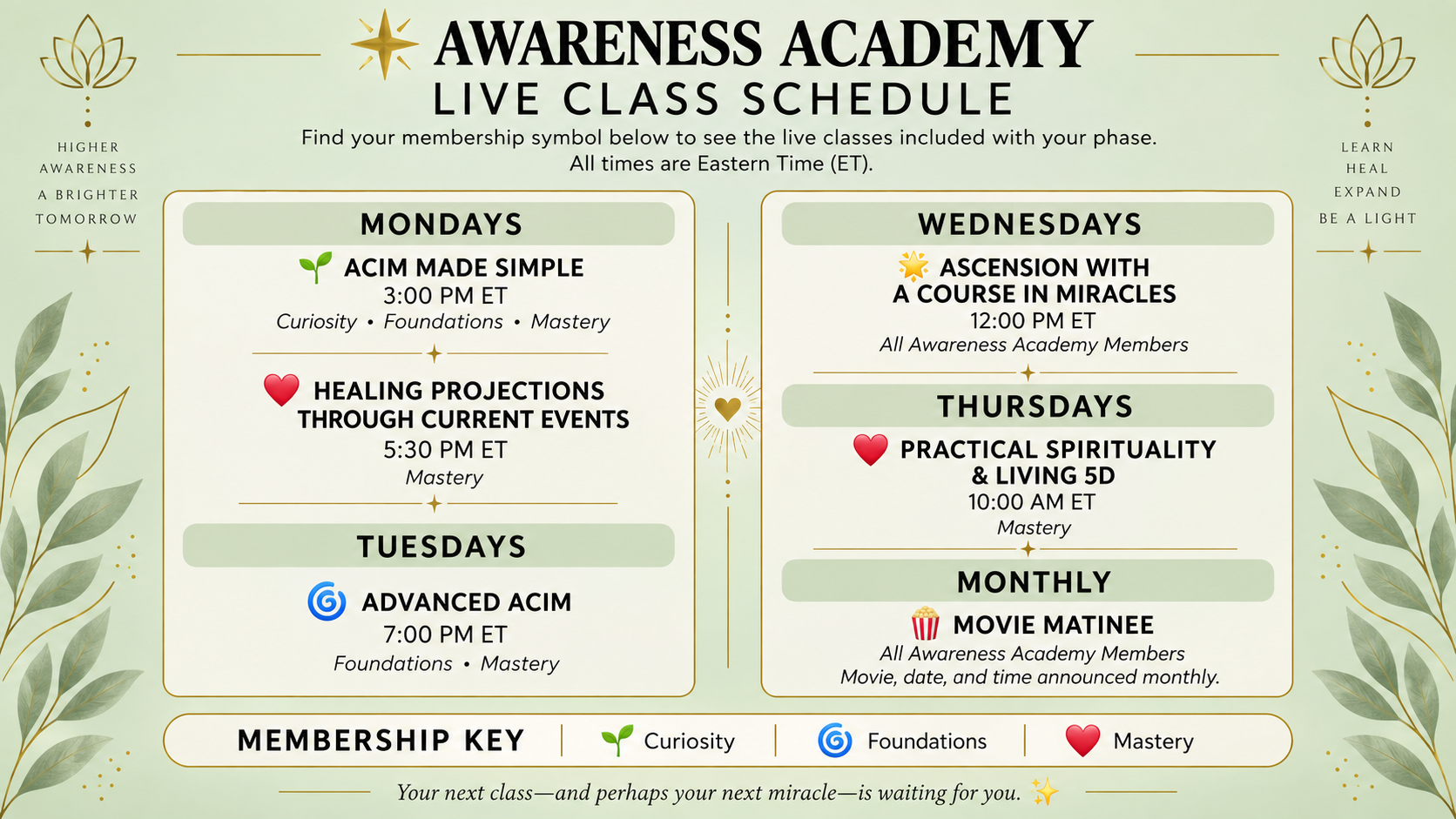
Here's a list of our ongoing classes:




Responses